


What If? The Big 16

In the 1990s, the landscape of college sports was changing rapidly. Penn State, spurned by its dream of forming a northeast football conference years before, would join the Big 10. Arkansas, which had been poached by the SEC from the Southwest Conference in 1991, they were soon joined by South Carolina later that same year. The Big East would add five teams to its football ranks in 1991. The WAC ballooned to 16 teams in 1996 before half the schools left to form the Mountain West in 1999. Conference USA would form from the ashes of the Southwest and Metro Conferences in 1996. In the Heartland of America, the wheels of destiny were in motion in Kansas City, Missouri. Following the landmark 1984 NCAA vs Oklahoma case, schools and conferences were free to negotiate TV deals for themselves. This sent shock waves throughout college athletics, causing many of the issues that we see today with realignment.

While conferences started to scramble to secure the best members to help boost the viewership, the then Big 8 stood pat. Well, at least in front of the media, as behind the scenes, schools like Kansas and Missouri were being courted by the Big 10 to join. The Pac-10 tried to steal Colorado as early as 1994, but this was squashed by the CU board, which voted against the move.
This isn’t to say that the Big 8 wasn’t looking for new members themselves, and they did have their eyes set on some targets, mainly in the southwest.

Both the Big 8 and the SWC had talks about merging into a 16-team super conference as early as 1992. Now, eventually, it was decided mainly by Texas that only 4 Texas schools would get the life raft out of the sinking ship known as the Southwest Conference. Texas, Texas A&M, Texas Tech, and Baylor would join the Big 8 to form the Big 12 in 1996.

It has been said that Baylor got into the Big 12 because then Texas Governor Ann Richards was an alumna of both Baylor and Texas, and for the move to be approved, it would have to be blessed by her. This was disproven; however, it is still a bone of contention between Baylor and the school that was seen to be in a much stronger position than TCU. But they weren’t the only ones who could’ve joined the party. BYU, Louisville, Memphis, and New Mexico had been in talks to potentially join the conference. With the two strongest rumored being BYU and New Mexico. Now, none of these teams would be added to the Big 12 until BYU joined in 2024, one can’t help but wonder what could have been? What If? What if the Big 12 went to 16 teams?
What could a Big 16 look like? Well, it could be very easy to say the modern Big 12. It feels disingenuous to leave that as the answer. So, let’s go over all the options the Big 8 had to join to form a possible Big 16. Well, for starters, the SWC was an eight-team conference made up of all Texas schools following the departure of Arkansas in 1991. Texas, Texas A&M, Texas Tech, TCU, SMU, Baylor, Houston, and Rice made up the conference.
With the other options being those of the aforementioned BYU, Louisville, Memphis, and New Mexico. We can start by removing a few of these teams right off the bat. Sorry Rice, SMU, and Houston, as by the time of the SWC-Big8 merger, the best years for all four schools had come and passed in football and basketball. Additionally, Memphis in 1996 did not have a strong enough case to become a Power 6 school in either football or basketball. This leaves us Texas, Texas A&M, Texas Tech, TCU, Baylor, BYU, Louisville, and New Mexico, who were the strongest contenders for membership. Many may be puzzled by New Mexico until you remember what was driving conference realignment at this time: TV markets. Albuquerque does have a large tv market, which, coupled with New Mexico’s success in basketball, was a massive driving factor in them being considered.

That makes the Big 16 be made up of Missouri, Colorado, Iowa State, Kansas State, Oklahoma State, Nebraska, Oklahoma, and Kansas from the Big 8, and Texas, Texas A&M, Texas Tech, TCU, Baylor, BYU, Louisville, and New Mexico joining them. This does leave Louisville out on its own island, however, much like the Big 12 would do with another school in the future that was farther out, I do think it would work out very well. The thought of the Louisville basketball teams of the 2000’s doing battle with Kansas, Baylor, Missouri, Kansas State, and Iowa State.

A 2012 Baylor vs Louisville matchup at the Sprint Center in the Phillips 66 Big 16 tournament, for who faces a Missouri team that may not be departing for the SEC in the championship alone, would make for amazing TV. New Mexico’s return to dominance in basketball is coming about the same time as Oklahoma State and Iowa State’s rise. The 2011 match-up of TCU vs Oklahoma State with the Big 16 football crown on the line.
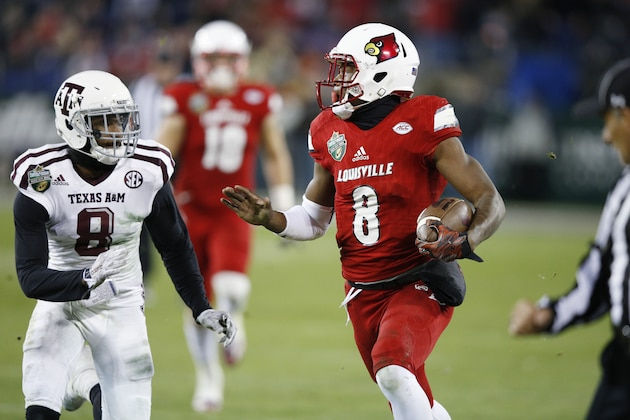
Lamar Jackson vs Patrick Mahomes on a random Saturday in September. Would this be enough to keep schools like Nebraska, Colorado, Missouri, and Texas A&M from leaving due to Texas bullying the conference?
In all honesty? Probably not, as Texas’s ego was the reason for 6 team leaving the real-life Big 12. As a reliance on Texas for TV revenue and the creation of the Longhorn Network was the final straw for schools like Nebraska and Missouri. However, with a Big 16 that would have every major TV market in Texas, the conference might not put so much stock into Texas, and by extension, the Longhorn Network, which was nothing more than a cash grab by Texas.

There is a strong chance that instead of Nebraska, Colorado, Missouri, and Texas A&M leaving, it could be Texas walking away from the conference in 2011, as a conference with much stronger TV markets would see the Longhorn Network for what it was. A thinly veiled vanity project for Texas. As for where the Longhorns would go, it could be the Pac-12. Who now, without Colorado, would be looking for a 12th member to join Utah, or could the doomsday scenario of 2010 happen? Which was Texas takes what basically is the Big 12 South, minus Oklahoma State, and brings Colorado with them to the Pac-10 to form the Pac-16. Also unlikely, as the only schools in our timeline that liked that idea were Texas and Colorado, and with a Texas that could be seen as less of a threat and more of the spoiled kid in the Big 16, it’s even less likely anyone feels that froggy as by 2011, even Texas A&M was fed up with Texas. Which fueled the Aggies to jump to the SEC in our timeline. Who could replace a departing Texas? Well, a school that joined the Big12 in our timeline makes the most sense: West Virginia. Any further speculation as to how the modern college football landscape changes couldn’t be made with any better idea than the shockwaves we’ve made so far. I do have a few non-Big 16, however. Notre Dame joins the Big 10 instead of Nebraska, Rutgers, or Maryland, as without Nebraska, there is less reason to add schools that don't fit the Big 10 mold, and Boise State joins the Pac 12 instead of Utah.

Which drives Utah to its rival, BYU, in the Big 16. Texas and Baylor leave the Big 16, going to either the SEC or Pac 12, with a stronger chance of the SEC. Why would Texas bring Baylor to the SEC? Well, Baylor could be the only ally that Texas would have left in this timeline after tossing a life preserver to the Bears in 1996. A lot of schools were very angry about the Longhorn Network. Including Oklahoma, which sucked it up because schools like Nebraska and Missouri were leaving. There is a strong chance that the Sooners end their rivalry with Texas due to the Longhorns' own greed, much like the Sooners did to Bedlam in our timeline.

Now, why would they do that? Honestly, they may not have much of a choice. Similar to the end of the Border War between Missouri and Kansas, one school may just not want the rivalry to continue. Things can get much stranger, so let’s stop right there. How do you think a Big 16 would have looked in 1996?


Comments